
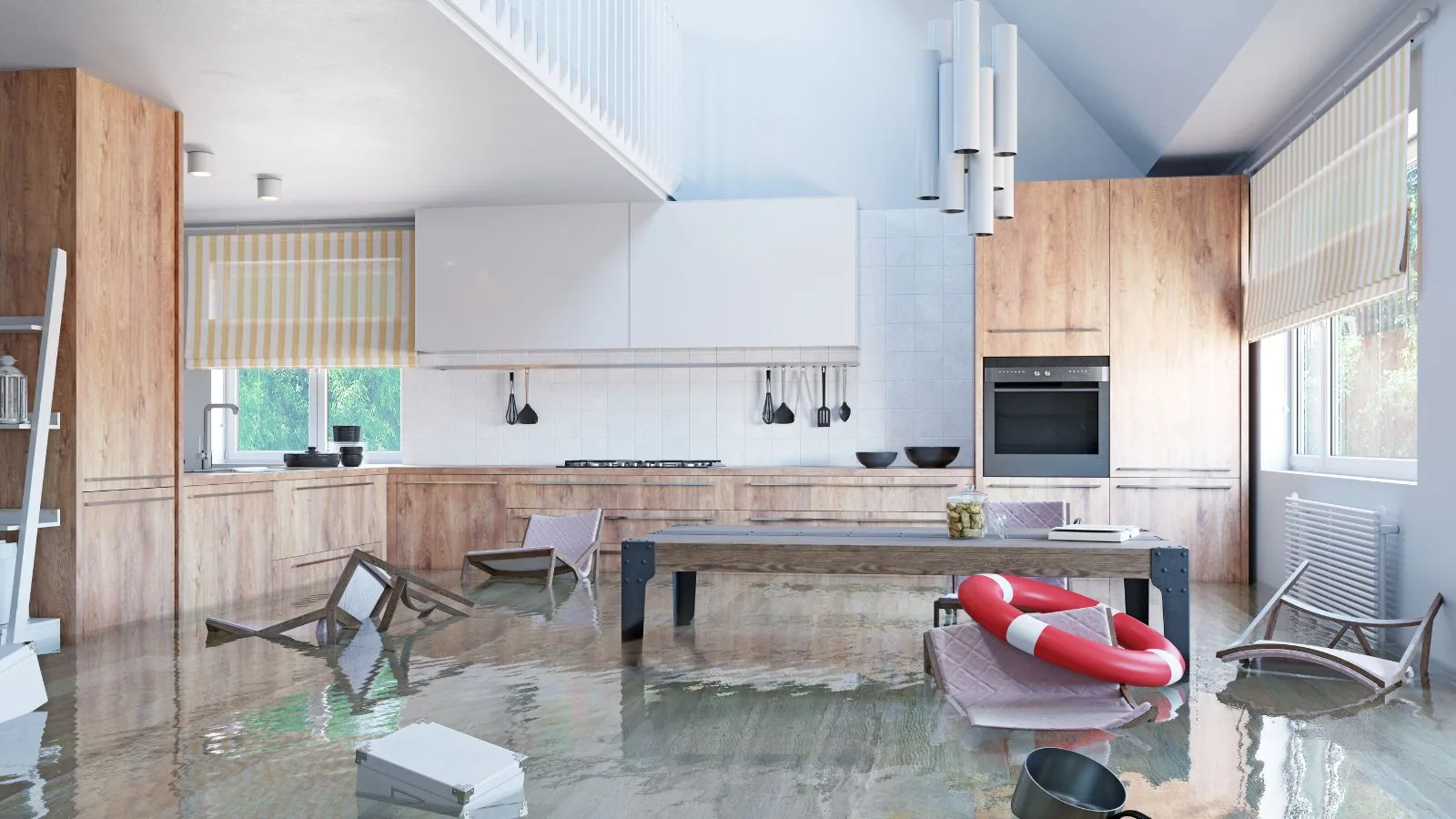
Why kitchen leaks do so much damage
A kitchen packs a sink, a dishwasher, often a refrigerator ice line and sometimes a disposal into a small space. A leak under any of them runs into cabinet bases, toe kicks and flooring, then spreads across the room.
Cabinets are the hidden cost. Particleboard boxes swell when wet and do not shrink back, so fast drying decides whether you replace one section or the whole run.
Kitchen water sources and where they hide
| Source | Warning sign | Where water travels |
|---|---|---|
| Sink supply or drain | Swollen cabinet floor under the sink | Cabinet base and toe kick. |
| Dishwasher | Warped flooring near the unit | Subfloor and adjoining cabinets. |
| Refrigerator line | Dampness behind the unit | Under flooring and walls. |
| Disposal or faucet | Drips on the cabinet bottom | Back of the cabinet and wall. |
How we dry and rebuild a kitchen
Find and stop
We confirm the source is shut off and note it for your plumber.
Pull toe kicks and open cavities
Lifting trim and drilling vents lets air reach wet areas behind cabinets.
Dry
Air movers and dehumidifiers dry cabinets, flooring and wall bottoms.
Repair
Swollen cabinet sections, flooring and drywall are replaced if they do not recover.
Which materials can be saved
Solid wood cabinets and tile floors usually dry well. Particleboard and laminate that stayed wet more than a day often do not. Hardwood flooring depends on how fast drying started, and our hardwood floor page explains the choices.
We tell you which items we expect to save and which to replace, using moisture readings rather than guesses.
Timing and urgency
A running line is urgent and the 24/7 line takes those calls, but a slow leak found under the sink can often be planned for the next day. Call either way, because moisture left under cabinets keeps doing damage.
Kitchen finishes and how each reacts to water
| Material | Reaction to water | Typical result |
|---|---|---|
| Solid wood cabinets | Absorb slowly and often dry back | Often saved with fast drying. |
| Particleboard cabinets | Swell at edges and do not return | Often replaced in the wet section. |
| Vinyl or laminate flooring | Seams lift and water gets under | Usually lifted and dried or replaced. |
| Tile with grout | Tile survives but the subfloor may be wet | Check the subfloor with a meter. |
What to do in the first hour at home
Shut off the valve for the source, empty the cabinet under the sink and set out towels, then call. Take photos of the cabinet floor, the wall and the flooring before you move anything.
Do not run the dishwasher or disposal until the leak is fixed. Running water through a bad line adds to the damage.
Countertops, appliances and what stays in place
Granite, quartz and laminate tops rarely need removal, but the cabinet below them can. If the cabinet has to come out, the countertop may need to be lifted, and that is a scope item we discuss before it happens.
Appliances such as the dishwasher and refrigerator are pulled so we can reach the floor beneath. We reconnect them only after the floor is dry and a plumber confirms the source is fixed.
Industry standard for kitchen water losses
ANSI/IICRC S500 is the published standard for professional water damage restoration. In a kitchen it helps decide whether cabinet bases and subfloor can be dried or must be removed, based on the water source and how long it stood.
We cite it as an industry document that guides our process. It is not a claim that we hold a certificate.
What affects the cost
Cost factors
Cost follows how many cabinets and how much flooring were wet, how long the leak ran and the finish level of the kitchen. Custom cabinets cost more to replace than stock ones.
We explain scope and price before work starts.
Insurance and related services
Insurers differ on sudden and gradual leaks, so ask about yours and describe the loss as water damage. Photograph the source, the cabinets and the floor. See appliance leak water damage for dishwasher and fridge failures and structural drying for the drying step.
Questions people ask
Active leaks are taken on the 24/7 line at any hour. Slow leaks can usually be scheduled.
Not always. Solid wood often dries, while particleboard that swelled usually does not recover. We check with readings.
No, a plumber does that. We handle water removal, drying and rebuild.
If it leaked, we check the floor under it and the neighboring cabinets, then explain the plan.
Many jobs take several days, depending on materials and the amount of water.